
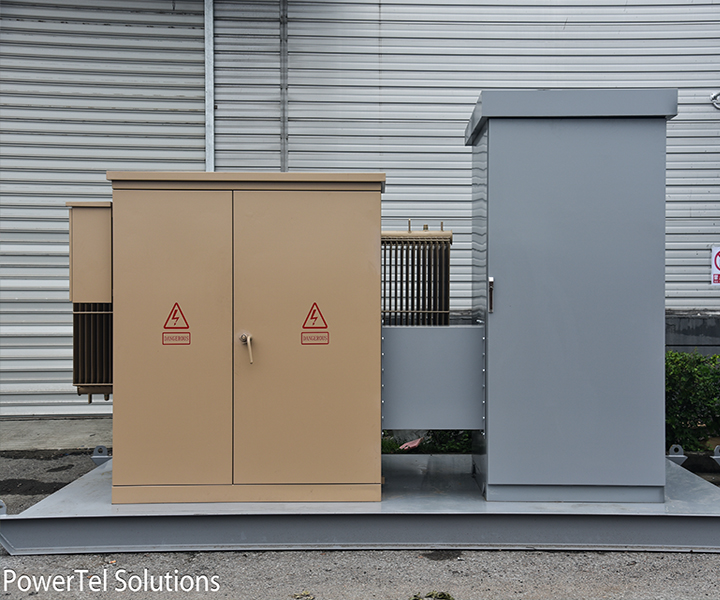
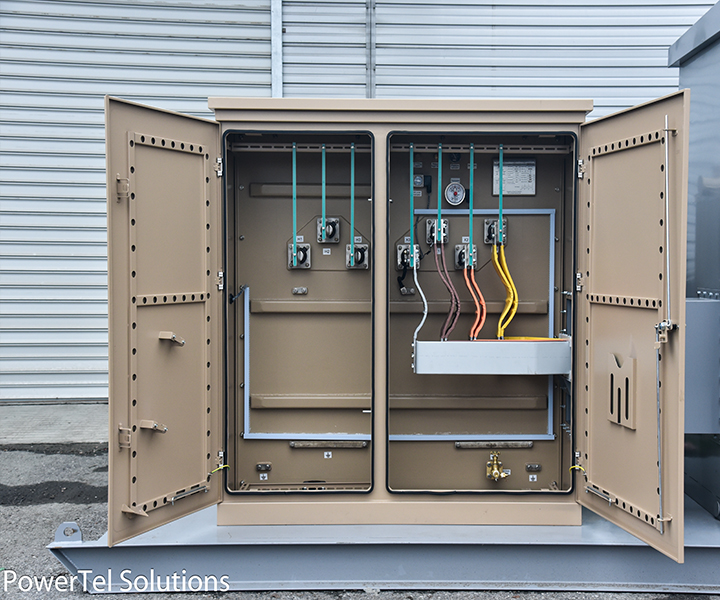
We are gland to introduce our newly innovated “combo transformer”—a skid-mounted unit integrating the transformer and switchgear. Hundreds of units have have already delivered to different job site and are scheduled to go into operation within the coming weeks. The assembly features a unitary steel skid base, a mounting frame, vibration-damping components, and heat dissipation elements. The transformer and switchgear are mounted atop the skid and interconnected via cables or copper busbars. Lifting lugs are installed at the four corners of the skid, and a custom-fitted mounting frame secures the equipment. Vibration-damping components are installed between the equipment and the skid. High-precision assembly, electrical interconnection, and performance testing are standardized and completed at our factory in China; consequently, no complex assembly is required on-site—only the connection of external cables. This reduces the workload for foreign electricians by over 80%, making it perfectly suited for the high-labor-cost environments of European and North American countries, while significantly lowering total project costs and accelerating construction schedules.
Furthermore, we offer customized switchgear designs and fabrication, incorporating various brands of MCCBs, metering equipment, and other electrical components to ensure full compliance with your project specifications.
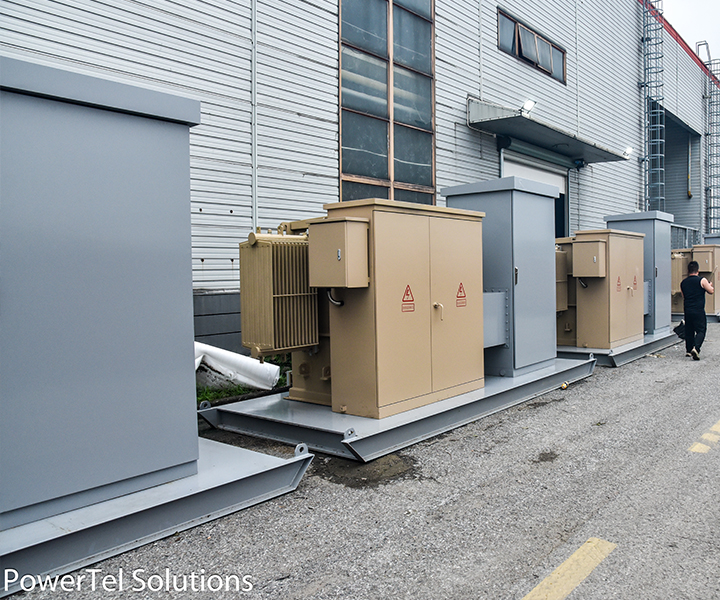
Background of this combo transformer/skid-mounted transformer:
There is a growing demand for power transmission and distribution equipment in overseas power projects, particularly for computing facility (data center or bitcoin mining factories) construction in Europe and North America. Traditional equipment typically follows a “split-supply” model, where transformers and switchgear are manufactured and transported as separate, independent units, requiring on-site assembly after delivery.
Traditional split-unit systems require extensive on-site work, including alignment and calibration of the transformer and switchgear, busbar interconnection, cabling, and comprehensive system testing. These tasks demand high levels of professional expertise and must be performed by certified, skilled foreign electricians. In Europe and North America, high labor costs mean that extensive on-site assembly and testing drive up total project expenses. Additionally, on-site construction is susceptible to variables such as personnel skill levels and site conditions, making project timelines difficult to manage and potentially delaying the commissioning of the computing facility. In contrast, split-type equipment requires the separate casting of independent mounting bases and necessitates reserved safety clearances between units; this results in a large overall footprint and low land-use efficiency, making it ill-suited for the compact sites and space constraints typical of computing power equipment rooms. Furthermore, assembly relies entirely on manual labor on-site, leading to significant fluctuations in assembly precision due to human factors and compromising the equipment’s structural integrity. Even after on-site assembly, issues such as loosened connections can arise during subsequent transport or long-term operation, resulting in unstable performance and potential electrical safety hazards.
Therefore, there is a need for a new skid-mounted integrated power distribution unit to address these technical issues.
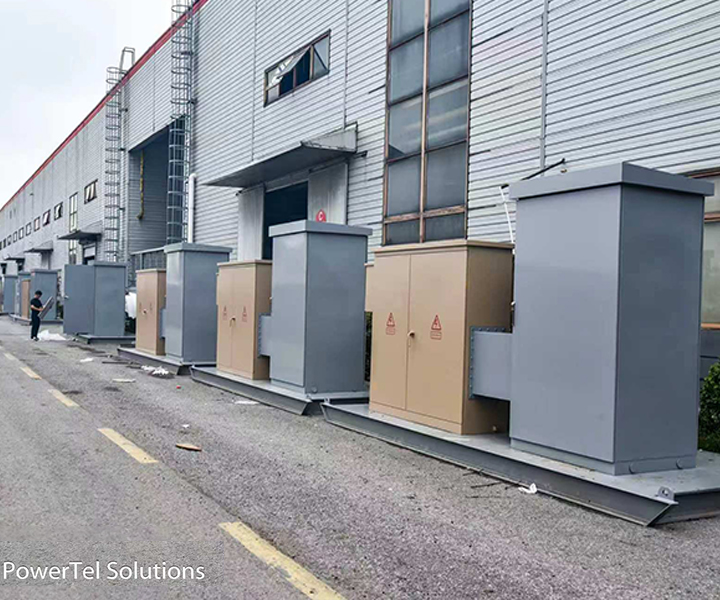
Combo transformer/skid-mounted transformer
This innovative product primarily comprises a base skid, a mounting frame, shock-absorption assemblies, heat dissipation fins, and a heat dissipation assembly. The base skid features a unitary steel structure, with a transformer and a switchgear unit mounted on its top surface and electrically connected via cables. Lifting lugs are installed at the four corners of the base skid, and a mounting frame—configured to accommodate the transformer and switchgear—is also installed on the top surface. Shock-absorption assemblies are positioned between the base skid and the transformer/switchgear units to mitigate the impact of transport-induced vibrations on internal components. Heat dissipation fins are installed at equal intervals along the rear of the transformer, and a heat dissipation assembly is installed between the base skid and the transformer/switchgear units to facilitate internal cooling.
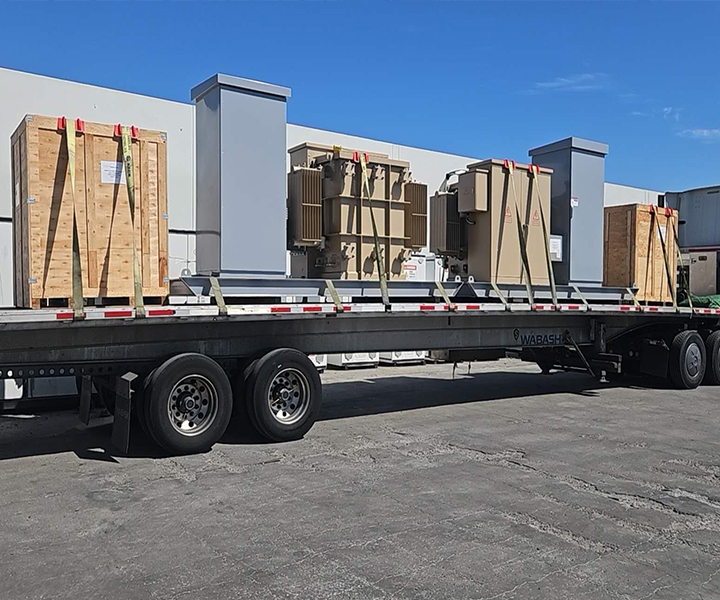
Preferably, the shock-absorption assemblies include shock-absorbing pads and rubber sleeves. The shock-absorbing pads are fixedly connected within the mounting frame, with their bottom surfaces abutting the top of the base skid and their outer sidewalls abutting the inner walls of the mounting frame. The transformer and switchgear are placed atop their respective shock-absorbing pads, and positioning sleeves are symmetrically fixed to the left and right sides of both the transformer and the switchgear, with rubber sleeves fixedly connected to the inner walls of these positioning sleeves. Preferably, bolt rods corresponding to the positioning sleeves are fixedly connected to the top of the base skid; the positioning sleeves are fitted over the corresponding bolt rods; the outer walls of the bolt rods fit against the inner walls of the corresponding rubber sleeves; cushioning gaskets are fitted onto the outer walls at the top ends of the bolt rods; and nuts are threadedly connected to the top ends of the bolt rods.
Preferably, the heat dissipation assembly comprises an electric push rod, an oil cylinder, and a first piston plate; a mounting base is fixedly connected to the center of the top of the base skid; the electric push rod and the oil cylinder are fixedly connected to the top of the mounting base; the output end of the electric push rod extends into the oil cylinder and is fixedly connected to the first piston plate; and oil supply pipes are symmetrically connected to the side wall of the oil cylinder at the end distal to the first piston plate.
Preferably, heat dissipation slots are spaced equidistantly along the upper rear sides of the transformer and the switchgear cabinet; piston cylinders are fixedly connected to the inner rear walls of the transformer and the switchgear cabinet; a second piston plate is slidably connected within the central portion of each piston cylinder; a push rod is fixedly connected to the center of each second piston plate; and the top end of each push rod extends out from the top of the corresponding piston cylinder.
Preferably, a closing plate corresponding to the heat dissipation slots is slidably connected to the inner rear wall of both the transformer and the switchgear cabinet; through-slots corresponding to the heat dissipation slots are spaced equidistantly within each closing plate; the top end of each push rod is fixedly connected to the corresponding closing plate; and a temperature sensor is fixedly connected to the inner rear wall of the transformer above the closing plate.
Preferably, the end of one oil supply pipe passes through the side wall of the transformer and connects to the bottom side of the corresponding piston cylinder, while the end of the other oil supply pipe passes through the side wall of the switchgear cabinet and connects to the bottom side of the corresponding piston cylinder.
Preferably, ventilation slots are symmetrically provided within the base skid; the air outlet ends of the ventilation slots are located at and connected to the bottoms of the transformer and the switchgear cabinet, respectively; and a fan is fixedly connected to the top of the base skid, with its output end connected to the air inlet ends of the ventilation slots. Compared to existing solutions, this combo transformer/skid-mounted transformer offers the following advantages:
- Significant reduction in overseas labor costs: All high-precision assembly, electrical interconnection, and performance testing are standardized and completed at the domestic factory. There are no complex assembly tasks required on-site—only the connection of external cables—reducing the workload for foreign electricians by over 80%. This is ideally suited for the high-labor-cost environments of Europe and the Americas, significantly lowering the customer’s total project cost.
- Space savings and suitability for computing facility environments: The compact, integrated layout eliminates the need for separate equipment bases and redundant safety clearances, reducing the overall footprint by 20%–30%. It is well-suited for AI data centers and computing base stations where space is limited and high power consumption is required, thereby improving site utilization.
- Greatly enhanced equipment stability and electrical safety: The integrated steel skid base offers high rigidity, ensuring no displacement or misalignment during lifting, ocean transport, or operation, and eliminating issues such as manual assembly misalignment or loose wiring. The unified grounding system is verified at the factory, and the cooling air ducts mitigate temperature rise during high-power, full-load operation, ensuring safer and more stable long-term, uninterrupted power supply.
- Shock-absorbing component design: This effectively prevents faults such as loose wiring terminals or busbar connection bolts during transport, significantly reducing the failure rate upon arrival at the site and lowering overseas after-sales maintenance costs.
- Heat dissipation component design: In high-temperature conditions, fans force air through the skid’s ventilation slots to the equipment base; working in tandem with the heat sinks at the rear of the transformer, this creates a forced-convection path (bottom-in, top-out) that ensures high cooling efficiency and keeps component temperature rise within safe limits. In low-temperature/high-humidity or coastal salt-spray environments, the cooling slots automatically close, effectively preventing the ingress of humid air, salt spray, and dust, avoiding condensation, and protecting the performance of insulation materials and preventing corrosion of metal components.
Please contact our experienced engineers about this combo transformer/skid-mounted transformer, provide you a tailored design for your project.
Email: info@powertel-solutions.com